
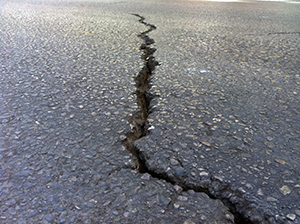
Worldwide, the emergence of large, but shallow earthquakes seem to occur on a mathematical scheme, called the devil’s Staircase. This means that a series of earthquakes separated by long but irregular intervals of seismic quiet.
The results, published in the Bulletin of the Seismological Society of America, differ from the model predicted by the classical simulation of earthquakes, which suggests that the earthquake will occur periodically based on cycles of accumulation and release of tectonic stresses. This means that periodic strong earthquakes are relatively rare. However, the analysis showed that this periodicity is different from traditional ideas.
Read Also
- COP27: “Agreement found” on the fund dedicated to repairing climate damage Nov 19, 2022
- Thomas Pesquet will find the space in 2021, with SpaceX Jul 28, 2020
- Nantes: The station’s new giant bicycle parking lot marred by “too many thefts” Nov 17, 2022
- To go to the countryside or the mountains, the best refrigerators for the car of 2021 May 30, 2021
- NASA Astronaut Reveals Space Flight Is Uncomfortable and Risky Aug 30, 2021
- They develop a battery of polypeptides that could be the future towards sustainable recyclable batteries May 28, 2021
- Weather Helsinki’s summer to become the hottest in the entire history of measurement – However, there may be a R Jul 9, 2021
The authors found that sequences of strong earthquakes (with a magnitude of 6.0 or more points) more intense than expected, and clustering of earthquakes in time leads to a higher probability of recurrence of seismic events shortly after a strong earthquake.
Stairs are the devil, sometimes called the Cantor function is a fractal, demonstrating nonlinear dynamic systems, in which change of any part can affect the behavior of the entire system. In nature this sequence, for example, can be detected in the sequence of sedimentation, changes in the rate of uplift and erosion, and changes in the Earth’s magnetic field.
